
Dermal Fillers & Biostimulators
What are Dermal Fillers and Why We Use Them
Dermal fillers are injectable treatments designed to restore lost volume, enhance facial balance, and soften certain lines and folds while maintaining natural facial movement.
Dermal fillers in Baton Rouge continue to increase in popularity despite some setbacks related to the overfilled look. The techniques and philosophy of the aesthetic industry have adjusted, and the conversation has shifted toward subtle, natural-looking results with preservation of facial balance.
In our Baton Rouge practice, facial balance has been the guiding principle of volume restoration regardless of purpose of the treatment.
The second most important principle is considering the long-term impact of filler, including the possibility of migration and effects on surrounding tissues.
Not one filler, but a family.
Hyaluronic Acid (HA)
Biostimulatory
Permanent
Where Dermal Fillers Can Help
Volume restoration
Wrinkle & fold correction
Contouring & sculpting
Scar correction
— 01
Cheek Filler
Lifting and contour — one of the most requested areas after weight loss.
Cheek filler stands out in facial balancing as both a lifting and contour-improving option. It can help address age-related changes in facial fat compartments and minimize a descended facial appearance. It is one of the most commonly requested areas after weight loss.
— 02
Cheekbone Filler
A sharper, more defined midface outline.
Usually requested when a sharper and more defined outline is needed. Highlighting the midface, cheekbone filler can enhance facial attractiveness and improve proportions when performed intentionally.
— 03
Jawline & Chin Filler
Definition, early laxity, and proportion — often treated together.
Jawline filler can contribute significantly to facial definition and improve the appearance of jawline contour. It is often used to address early laxity, enhance facial definition, and rebalance proportions in patients with a smaller jawline or chin.
Jawline and chin enhancement often go hand in hand and are frequently performed during the same session.
— 04
Nasolabial Folds & Marionette Lines Filler
Strategic placement over heavy correction.
Dermal fillers for nasolabial folds and marionette lines are also undergoing a transformation to avoid a heavy or over-injected look. Strategic placement can rejuvenate the face, and judicious use of fillers remains our best guardrail.
— 05
Facial Balancing
Subtle refinements across nose, forehead, lips, neck and décolleté.
Fillers can also be used for profile balancing when subtle refinements to the nose, forehead, or lips are performed in the same session to create more proportional results, or to restore volume in the neck and décolleté.
— 06
Body
Contour concerns, skin lifting, and biorejuvenation.
Body fillers are less common but can be a useful tool for specific contour concerns, skin lifting, and biorejuvenation.
Lip Filler
Lip filler is very popular in our practice for a simple reason: lips are a symbol of attractiveness, sensuality, expression and connection. They enhance communication not necessarily through the words, but through smiles, laughter and other expression of emotions — and fillers can change them entirely. Enhancing lips with lip filler can be as much about changing someone’s appearance as about enhancing harmony, highlighting the natural beauty and boosting confidence.
Lip filler is usually a hyaluronic acid filler specifically designed for lip augmentation. It can increase volume, change shape, symmetry and definition of lips. A good candidate is usually looking for aesthetic lip enhancement, improved symmetry, better definition or improvement in age-related changes. The techniques for lip filler vary and the combination of those will offer the best result.
Occasionally we encounter a new client looking for improvement from previous filler, and the most common problem we see is migration. There are various reasons for it, but overfilling is most common along with imprecise placement. The solution is restructuring using filler dissolver and new filler injection sessions.
Lip Filler — questions
How long does lip filler last?
Lip filler lasts approximately one year. The longevity of lip filler can vary depending on the product used, individual metabolism, lifestyle factors, and the amount of movement in the lips.
Does lip filler hurt?
The lips are one of the most sensitive areas of the body, and pain management in our practice is a priority. We usually offer the option of a nerve block, topical cream, or a combination of both. Most clients find their pain level very manageable.
How much filler is needed for natural looking lips?
Usually, as little as half a syringe can make a measurable difference in lip appearance. Another option is using one syringe divided between the body of the lips and surrounding areas for the most natural look.
What is natural lip filler?
Natural lip filler means enhancing the lips while maintaining facial harmony, movement, and individual proportions rather than creating excessive volume. This can be achieved through restrained volume enhancement, careful product selection, precise technique, and in some cases complementary treatments such as PRF gel or dermal boosters. Ultimately, the approach depends on the amount of volume increase desired and the patient’s goals.
Tear Trough Filler
Tear trough filler is less about enhancement and more about improvement. It can help resolve a tired, hollow appearance, making it a strong choice after significant weight loss. With modern techniques, it can provide a powerful rejuvenating transformation.
In the case of under eye filler, less is more. We try to avoid sharp corrections that may not age well with the face.The tear trough area is treated with lighter, more flexible filler products to minimize the risk of discoloration and bulging.
In this area, technique and understanding how filler ages over time are especially important because it is technically demanding and anatomically unforgiving.
Tear trough filler — questions
How much under eye filler is needed to correct tear trough volume loss?
Sometimes as little as half a syringe can make a significant improvement. Again, less is more in this area, and a follow-up session is often a better choice than placing a full syringe at once.
Is tear trough filler painful?
Tear trough filler does involve an injection, but it is usually performed using a cannula, which minimizes discomfort.
Can tear trough filler get rid of dark circles?
Tear trough filler can effectively reduce the appearance of dark circles, but only when the dark circles are primarily caused by structural volume loss, such as hollowing or shadowing. It is very important to understand the underlying cause because not all dark circles are the same. Pigmentary dark circles do not improve with filler, and vascular causes may only be partially improved. Fortunately, many tear trough concerns are mixed, and filler can help or provide improvement in appropriately selected patients.
Dermal Boosters / Biostimulators
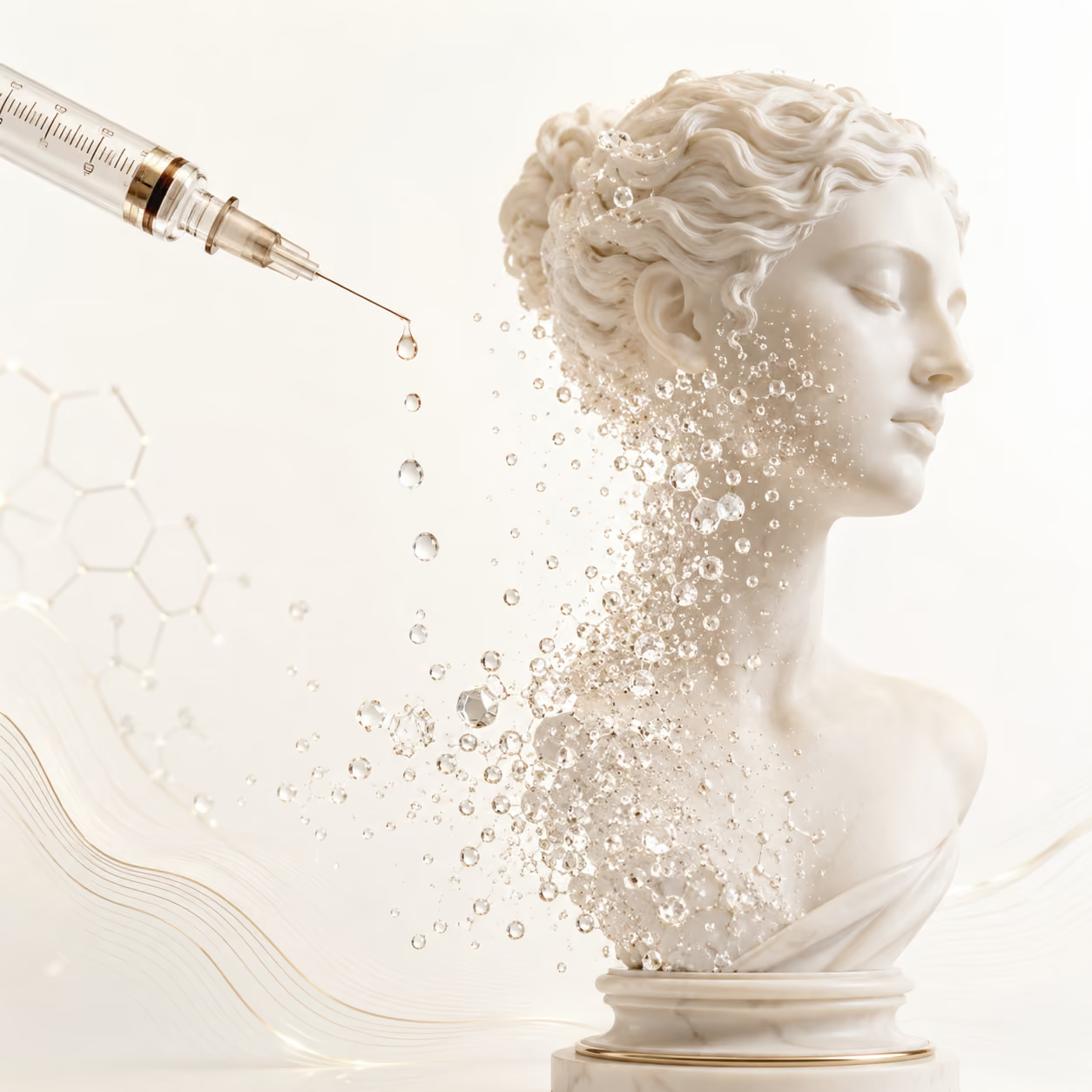
Dermal boosters are injectable treatments designed to improve intrinsic skin quality — hydration, elasticity, luminosity and texture — rather than provide volume. They are rapidly becoming a cornerstone of the modern “skin quality” aesthetic path.
While traditional fillers add volume by occupying space beneath the skin, skin boosters, by contrast, are injected as microdroplets throughout the dermis to improve hydration, stimulate extracellular matrix production, and support overall skin health. They behave more like solutions than gels.
Major categories of dermal boosters include HA-based products, PN (polynucleotide) and PDRN formulations, and liquid PRP and PRF.
Boosters work with the skin rather than on top of it — hydration, elasticity and luminosity built from the dermis outward.
The regenerative toolbox
— 01
PDRN (Salmon DNA)
Regeneration, repair, and skin-quality signaling — not volume.
PDRN (polydeoxyribonucleotide) is a DNA-derived compound primarily obtained from salmon trout or chum salmon sources. It functions through tissue repair, anti-ischemic, and anti-inflammatory pathways to improve intrinsic skin quality. Newer sustainable sources of plant- and microalgae-derived PDRN are becoming available and may offer comparable bioactivity. PDRN and PN (polynucleotides) are not the same compounds, although they share some similar properties.
PDRN effects include skin regeneration, improved wound healing, collagen synthesis, anti-inflammatory activity, anti-senescent effects, improvement of hyperpigmentation, and photodamage repair. At Metaglow, PDRN is used as part of a skin-quality approach focused on improving texture, hydration, and regenerative signaling rather than adding volume.
— 02
GHK-Cu (copper peptide)
A tripeptide that declines with age — applied topically after microneedling.
GHK-Cu is a naturally occurring tripeptide found in human plasma, saliva, and urine. Plasma levels decline by more than 50% by the age of 60, a decline that naturally coincides with a significant reduction in the regenerative capacity of human skin.
GHK-Cu has strong biological potential as a skin booster, although its clinical evidence base is primarily derived from topical application studies rather than injectable or mesotherapy protocols. It upregulates collagen production and remodeling, exerts anti-inflammatory and antioxidant effects, increases growth factor signaling within the skin, and may improve vascular support. It has demonstrated the ability to influence gene expression, with studies suggesting modulation of thousands of genes. Topical GHK-Cu in some studies increased skin collagen production by 70%, while Vitamin C by 50% and retinol by 40%.
In our Baton Rouge clinic we offer topical application after microneedling, which significantly increases the dose of GHK-Cu delivered throughout the skin. Injectable GHK-Cu applications are still in early stages of development, and both injectable dermal boosters and GHK-Cu-loaded fillers remain in research and development. At the moment, GHK-Cu is not approved for injectable use.
— 03
Renuva®
An adipose-derived scaffold for subtle volume restoration.
Renuva is an adipose-derived regenerative product designed to restore soft tissue volume and support natural tissue remodeling. Unlike traditional fillers that provide volume through a gel implant, Renuva works as a biologic scaffold intended to support the body’s own regenerative processes.
Renuva can be considered for patients seeking subtle volume restoration, especially in areas affected by age-related volume loss or tissue changes. As with any regenerative aesthetic treatment, appropriate patient selection and realistic expectations are essential for achieving natural-looking results.
Reference
Pickart L, Vasquez-Soltero JM, Margolina A. “GHK Peptide as a Natural Modulator of Multiple Cellular Pathways in Skin Regeneration.” BioMed Research International. 2015;2015:648108.
Often paired with
Last medically reviewed by Emma Kruger, M.D. · July 25, 2026
