
Laser & Light-Based Skin Rejuvenation
Energy-based treatments for texture, tightening, pigmentation, and lift — matched to your skin’s actual depth of concern.
Energy & Light-Based Rejuvenation
Our energy-based devices, light, radiofrequency or ultrasound, perhaps best viewed in the context of the skin needs and specific outcomes desired. In our practice we start with client’s actual concern and match it to the device, depth and settings that addresses it.
Texture & Glow Refinement
BBL (BroadBand Light) is a non-coherent, filtered flashlamp treating the spectrum of roughly 400–1200 nm. Filter selection (515, 560, 590, or 640 nm) targets melanin or hemoglobin depending on whether the priority is pigment, redness, or general photorejuvenation. Beyond visible pigment and vessel clearance, BBL has been shown to shift the gene expression pattern of aged skin back toward a more youthful profile — the basis for using it as a repeated, maintenance-style treatment rather than a single correction.
Broad Band Light (BBL) is an advanced form of the intense pulsed light (IPL) that uses high intensity pulses of light to treat various skin conditions such as pigmentation, redness, sun damage and age-related changes such as uneven tone or texture, fine lines and light capillaries. BBL treatment is usually a series of 3-4 treatments followed by maintenance once or twice a year. Each single BBL treatment addresses multiple concerns and improves overall skin clarity and radiance over the course of 3-4 sessions. It is less effective for the deep lines and wrinkles and should not be used after sun exposure and in freshly tanned skin. Care should be taken in darker skin tones.
— 01
SkinTyte (Infrared Light)
Dermal water as the target — no downtime, no surface disruption.
SkinTyte uses infrared broadband light (roughly 1100–1800 nm) to heat dermal water directly, with contact cooling protecting the epidermis. It is not a laser and not radiofrequency — it’s the same flashlamp family as BBL, filtered to a different wavelength band, with water rather than melanin as the target chromophore. No downtime, no surface disruption, best used as a series of 3–5 sessions.
— 02
Laser Peel — Light Setting (10–30 μm)
A precisely controlled “lunchtime peel.”
At its most superficial setting, the Er:YAG Laser Peel removes only the stratum corneum to upper epidermis — a precisely controlled “lunchtime peel” with 1–2 days of mild redness. Even at this shallow depth, the wound-healing response triggers measurable new collagen production, because the skin doesn’t need to be cut deep to be told to rebuild.
— 03
ProFractional — Shallow Setting (100–150 μm)
A fractional refresh with minimal downtime.
ProFractional isn’t only a deep-collagen device — dialed to 100–150 μm, it functions as a fractional refresh: brightening tone and refining texture with minimal downtime, well short of the deeper collagen-remodeling settings used for scarring or laxity.
questions
How BBL treatments is different from LED treatment
BBL uses higher-energy broadband light to selectively target pigmentation, visible blood vessels, and stimulate collagen remodeling. LED uses low-level light to support cellular activity and skin recovery without the thermal effect of BBL. The two treatments work differently and can complement each other depending on your skin goals.
How BBL Skin Tyte is different from IR sauna
While SkinTyte delivers precisely controlled, high-fluence, pulsed near-infrared light to selectively heat the dermis to collagen-remodeling temperatures, the IR sauna emits continuous, low-power far-infrared radiation (3,000–10,000 nm) that heats only the skin surface for systemic warming. So the biggest difference is wavelength and penetration depth.
Fine Lines & Early Wrinkles
— 01
Laser Peel — Mid-Depth (Pinpoint Bleeding Endpoint)
Ablation crossing into true dermal tissue.
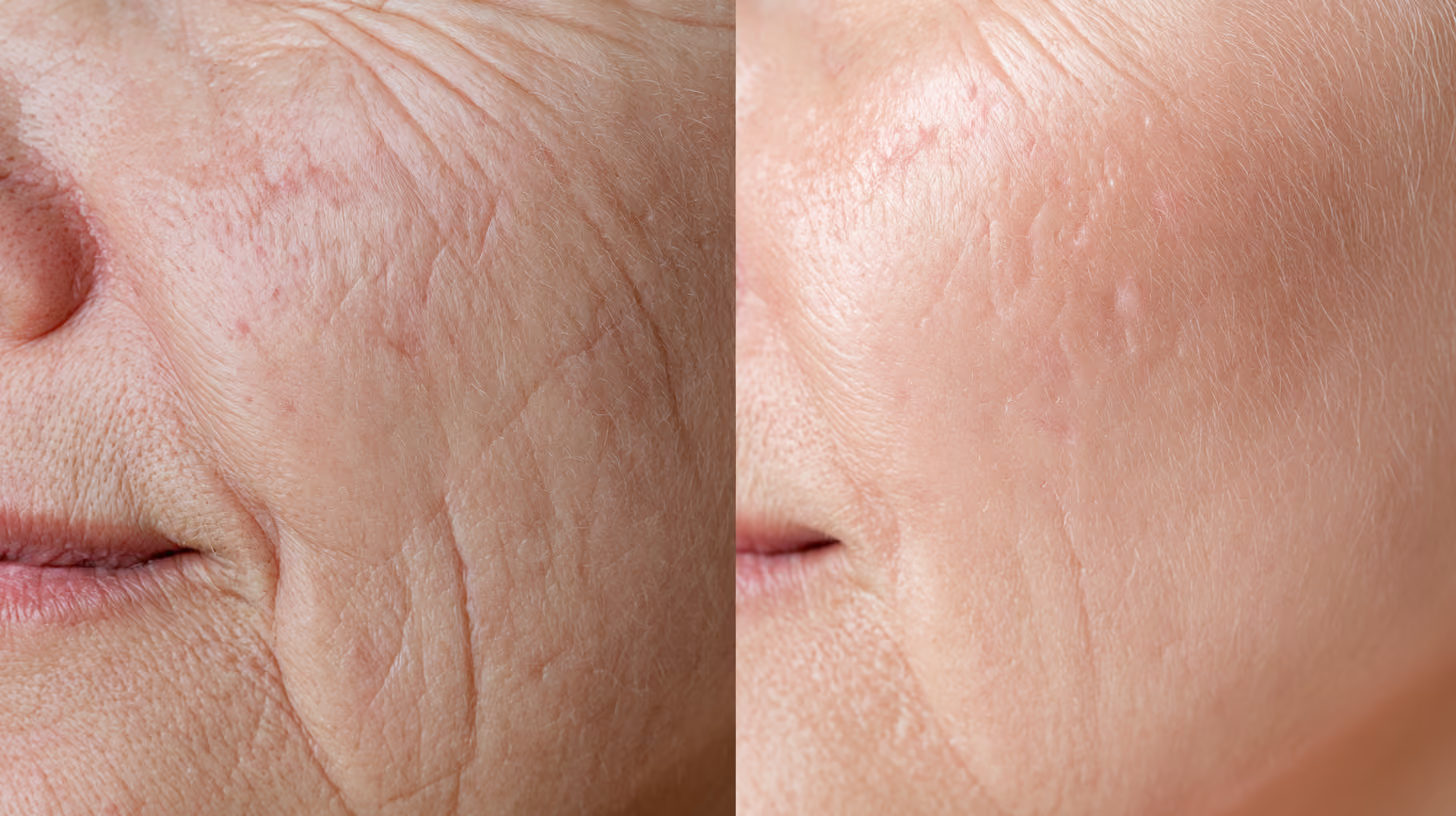
Before / After
Laser Peel · texture, wrinkles and lines
Pushed past the epidermis, the Laser Peel reaches the papillary-to-reticular dermis — the clinical marker is the appearance of pinpoint bleeding, which tells us the ablation has crossed into true dermal tissue. This is a meaningfully deeper treatment than the surface “refresh” setting above, with a longer, more deliberate wound-healing response and 3–5 days of downtime.
— 02
ProFractional — Mid-Depth (300–750 μm)
What most patients mean by “the fractional laser.”
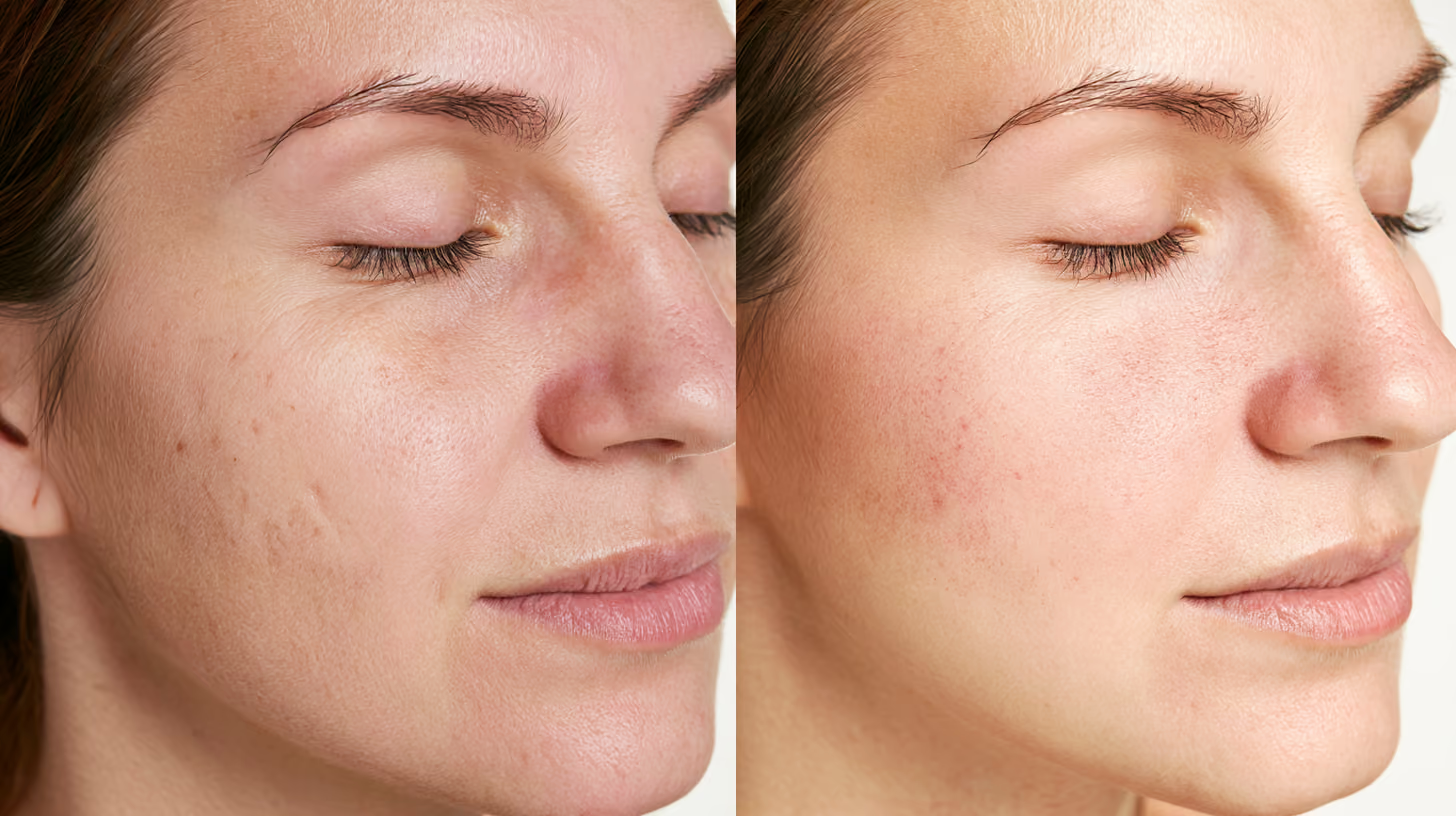
Before / After
ProFractional · pigment and tone
At moderate density and depth, ProFractional’s narrow ablation columns reach into the reticular dermis, triggering both immediate thermal collagen contraction and a longer neocollagenesis response over the following weeks — the setting most patients mean when they ask about “the fractional laser” for fine lines.
— 03
Morpheus8 — Stamping Technique with Dermal Boosters
Layered with PDRN, GHK-Cu, vitamins, and amino acids.
Our Morpheus8 protocol uses a gentle stamping technique at conservative RF settings, immediately followed by infusion of dermal boosters — including PDRN, GHK-Cu, vitamins, and amino acids — through the microchannels created by the treatment. This layered approach prioritizes steady, cumulative collagen support over aggressive single-session intensity. See more on PDRN and GHK-Cu
Deep Wrinkles, Scars & Advanced Photodamage
— 01
ProFractional — Deep Setting (up to 1.5 mm)
Reserved for moderate-to-severe scarring and collagen loss.
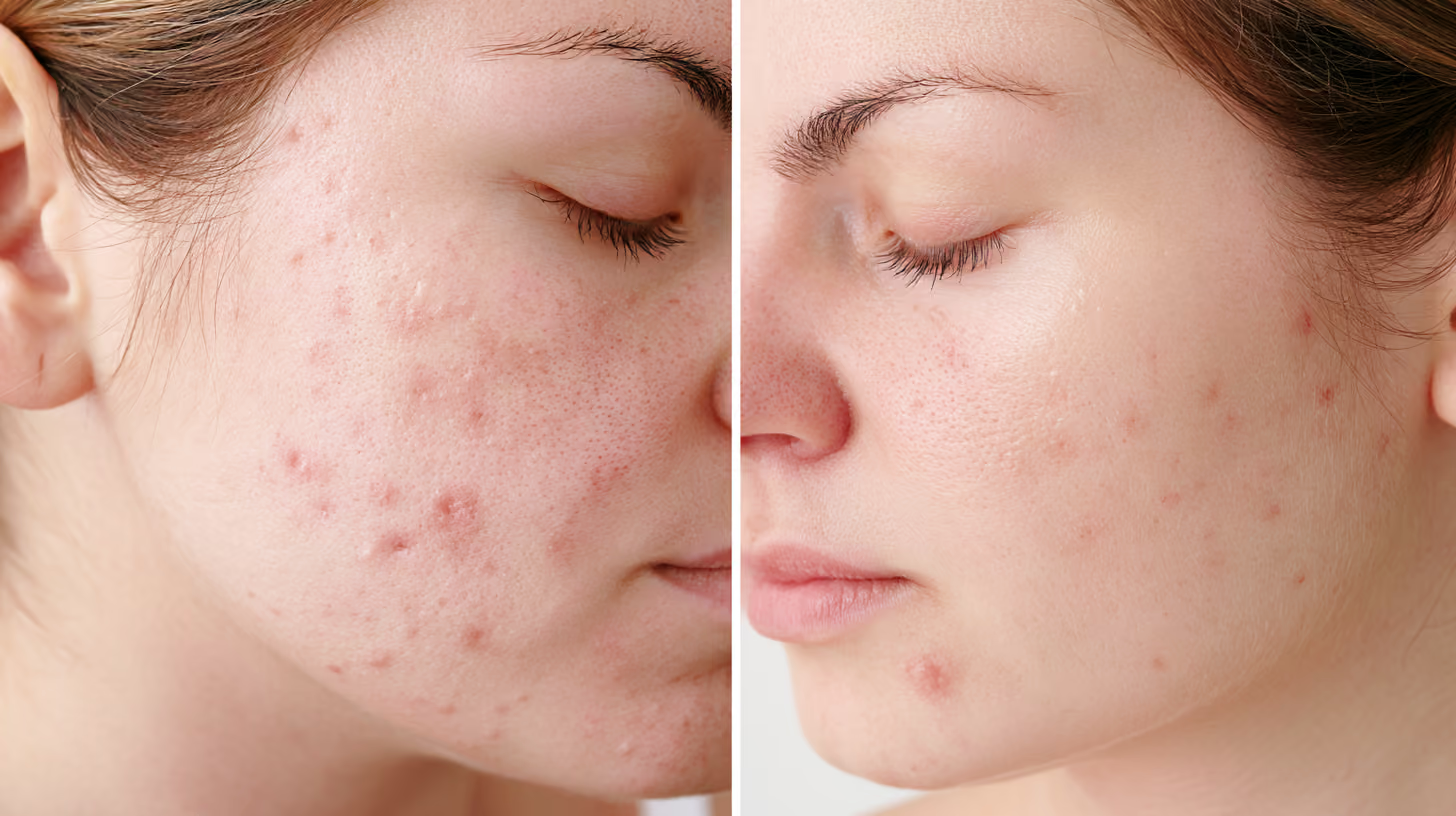
Before / After
ProFractional · acne and scarring
At full depth, ProFractional’s columns penetrate up to 1.5 mm into the reticular dermis, leaving surrounding tissue intact to drive a robust wound-healing response. This is the setting reserved for moderate-to-severe acne scarring, deeper wrinkles, and significant collagen loss — not a routine refresh.
Evidence: comparative studies of Er:YAG in superficial, fractional, and combined modes for acne scarring found the combined approach achieved the lowest scar severity scores and highest satisfaction, though with more downtime and pigmentation risk than either modality alone — which is why we default to sequencing rather than stacking everything in one session for most patients.
— 02
Laser Peel — Deep Resurfacing
Full-field removal rather than a pattern of columns.
Beyond the pinpoint-bleeding threshold, the Laser Peel can be taken into full-field deep resurfacing for significant scarring or advanced photodamage. This is a more aggressive, uniform treatment than ProFractional’s fractional approach — full-field removal of a tissue layer rather than a pattern of columns — with a corresponding increase in downtime and post-inflammatory pigmentation risk, particularly in deeper skin tones.
— 03
Stretch Marks
The same fractional and RF-microneedling principles used for scarring.
Stretch marks respond to the same fractional and RF-microneedling principles used for scarring — ProFractional or Morpheus8 stimulate collagen within the atrophic, thinned tissue of a stretch mark to gradually improve texture and color match with surrounding skin over a series of sessions.
Melasma, Rosacea & Pigmentation
BBL’s filter system is what makes it useful for both pigment and vascular concerns from the same platform. The 515 and 560 nm filters target melanin most directly for sun spots and epidermal pigmentation; the 590 and 640 nm filters shift toward hemoglobin, making them the better choice for rosacea, diffuse redness, and visible vessels. Melasma requires particular caution — heat-sensitive and prone to rebound pigmentation, it’s approached conservatively with lower fluences and always alongside strict sun protection.
Filter guide: 515 nm — most aggressive for pigment, higher risk in darker skin. 560 nm — balanced workhorse for general photorejuvenation, Fitzpatrick I–III. 590 nm — favors hemoglobin, safer in Fitzpatrick III–IV, good for rosacea. 640 nm — deeper vessels, safest filter for darker skin tones.
Tightening & Lifting
— 01
Ultherapy — Non-Surgical Lifting
The only device in our lineup that reaches the SMAS.
Ultherapy is the only device in our lineup that reaches the SMAS — the same structural layer addressed surgically in a facelift — using microfocused ultrasound rather than light, heat, or RF. Zero downtime, but results build gradually: expect initial change around 3 months, with continued collagen remodeling out to 9 months.
Ultherapy vs. Morpheus8 vs. ProFractional: Ultherapy reaches deepest (up to 4.5 mm, SMAS) with zero surface disruption and zero downtime, but no texture improvement. Morpheus8 (up to 4 mm) and ProFractional (up to 1.5 mm) both offer real tightening plus measurable texture improvement, at the cost of some downtime. Choice depends on whether the priority is a subtle structural lift or visible surface renewal.
— 02
SkinTyte & ProFractional for Tightening
Often the better starting point for early-to-moderate laxity.
For patients not ready for Ultherapy’s cost or timeline, SkinTyte and mid-to-deep ProFractional settings offer meaningful tightening with visible texture benefit as a bonus — often the better starting point for early-to-moderate laxity.
BBL + ProFractional — Our Combined Rejuvenation Protocol
Our signature protocol pairs BBL and ProFractional in a single session: BBL first, on intact skin, to clear pigment and vascular concerns and stimulate the gene-expression rejuvenation response described above; ProFractional second, to remodel collagen at a depth matched to your specific concern. We do not include a MicroLaserPeel step in this combination — the added downtime isn’t justified by the incremental benefit once ProFractional is already addressing the deeper tissue.
Why this sequence: BBL relies on an intact epidermis to selectively target melanin and hemoglobin — it has to go first. ProFractional’s fractional ablation follows, penetrating through the BBL-treated surface into the dermis. Published Sciton-platform data combining BBL with a superficial Er:YAG pass showed histological evidence of new collagen formation to 250–350 μm depth, with the largest gains in overall appearance and pigmentation, sustained past 3 months.
LED Light Therapy: Professional vs. Home Devices
Home LED and red-light devices are a legitimate, low-risk maintenance tool between office visits — they will not replace what BBL, ProFractional, Morpheus8, or Ultherapy accomplish, but they support skin health and can extend results between professional treatments. We recommend thinking of LED as daily upkeep, and the devices above this section as the actual corrective treatments.
Quick Comparison
Device
Energy
Max Depth
Best For
Downtime
BBL
Broadband light (400–1200 nm)
Epidermis/superficial dermis
Pigment, redness, glow, maintenance
0–2 days
SkinTyte
Infrared light (1100–1800 nm)
Dermis (water target)
Mild tightening
None
Laser Peel
Er:YAG 2940 nm, full-field
10 μm (light) to dermis (pinpoint bleeding)
Texture, tunable to scarring
1–7 days by depth
ProFractional
Er:YAG 2940 nm, fractional
100 μm (refresh) to 1.5 mm (deep)
Collagen remodeling, scarring, tightening
3–7 days by depth
Morpheus8
RF microneedling (stamping)
Adjustable, conservative in our protocol
Collagen support + PDRN/GHK-Cu boosters
2–5 days
Ultherapy
Microfocused ultrasound
Up to 4.5 mm (SMAS)
Structural lift, no downtime
None
Home LED
Low-level light
Surface only
Daily maintenance
None
Find the Right Treatment for Your Skin
Schedule a consultation and we’ll match your specific concern — texture, tightening, pigmentation, scarring, or lift — to the device and depth that actually addresses it.
Results vary by individual, skin type, and treatment parameters. All devices referenced are FDA-cleared for their respective indications. Consult with our clinical team to determine which treatment is appropriate for your skin and goals.
Last medically reviewed by Emma Kruger, M.D. · August 8, 2026
