
Hair Restoration

Approach
Hair loss is rarely just about hair.
It can be one of the first visible signs that something has changed — hormonally, metabolically, nutritionally, or simply with time. At Metaglow, we begin by looking for the reason behind the change before deciding how to treat it.
For some patients, that may include PRP/PRF. For others, medical therapy, correction of an underlying deficiency, or a combination of approaches may be more appropriate. The goal is not to treat the scalp in isolation, but to understand the biology behind the loss and preserve what is still possible to preserve.
Understanding hair loss
Hair Loss Is Not a Single Condition
The pattern, timing, and extent of shedding can offer important clues about what is happening beneath the surface.
Androgenetic alopecia — genetic, hormone-influenced thinning — is the most common form in both men and women. Other forms of shedding may be associated with thyroid dysfunction, depleted iron stores, nutritional factors, medications, significant stress, or age-related changes in the hair follicle. More than one factor may be present at the same time.
In androgenetic alopecia, follicles gradually become smaller and produce finer, shorter hairs. The growth phase of the follicle also becomes progressively shorter. A follicle that has miniaturized is different from a follicle that has been permanently lost — and that distinction is important when considering treatment.
This is why we do not begin with a procedure. We begin by determining what is contributing to the change.
“The appearance may be similar from one patient to another, while the biology behind it is quite different.”
Before treatment
A Medical Evaluation Before Treatment
A thoughtful hair restoration plan begins with an evaluation rather than an injection.
Dr. Emma Kruger begins with a detailed history and examination of the scalp, looking at the distribution and character of the thinning and, when appropriate, staging it with established classification systems such as Norwood-Hamilton or Ludwig.
A pull test and trichoscopy may provide additional information about shedding and follicular miniaturization. When the presentation suggests another underlying scalp disorder, additional evaluation may be appropriate.
The purpose is straightforward: regenerative treatments can support follicles that remain viable. They cannot recreate follicles that have been permanently lost.
Understanding the condition of the follicles therefore helps determine whether PRP/PRF is appropriate, whether another approach would be preferable, or whether several therapies should be combined.
Laboratory testing
Looking Beyond the Scalp
Depending on the history and examination, laboratory testing may be appropriate.
Common considerations include thyroid function, iron studies and ferritin, a complete blood count, and vitamin D. A more focused hormonal evaluation may be considered when the clinical picture suggests an androgen-related component.
If an underlying contributor is identified, addressing it becomes part of the treatment — not an afterthought.
For example, low iron stores may be relevant to shedding and are worth correcting when present. Correcting a deficiency, however, does not necessarily restore hair on its own. Hair growth reflects multiple interacting factors, and the treatment plan should reflect that complexity.
Where medical therapy fits
For some patients, medical therapy remains the foundation. Minoxidil can help prolong the growth phase of the follicle. Finasteride or dutasteride may be considered for appropriate patients with androgenetic hair loss, while spironolactone may have a role in selected women with hormonally influenced thinning. The appropriate treatment depends on the individual patient, the underlying diagnosis, and the risks and benefits of each option.
The treatment
PRP/PRF: Regenerative Support for Viable Follicles
Once the underlying picture is understood, PRP/PRF may be incorporated as a regenerative treatment.
The proposed biologic effects are relevant to follicles that are still present but have become compromised or miniaturized.
How platelet-rich fibrin works
Platelet-rich fibrin is prepared from a patient's own blood without anticoagulants. During processing, platelets and other blood components become incorporated into a fibrin matrix, creating a biologic scaffold at the treatment site. The attraction of PRF is its sustained local presence. Rather than simply delivering a concentrated platelet preparation, the fibrin matrix provides a structure within which platelets and signaling proteins are retained and released over time. It is important, however, to distinguish mechanism from clinical proof. The biology of platelet-rich products is well studied, but the evidence specifically supporting PRF for hair restoration remains less mature than the evidence for PRP. PRF is promising; it should not be presented as a proven replacement for established medical therapies.
The comparison
PRP and PRF: Different Approaches
PRP and PRF both use a patient's own blood, but they are prepared differently and have different physical characteristics.
Compare PRP and PRF side by side
Feature
PRP
PRF
Anticoagulants
Typically used during preparation
Prepared without anticoagulants
Platelets
Concentrated platelets
Platelets incorporated within a fibrin matrix
Fibrin matrix
Does not form the same type of fibrin matrix
Forms a natural fibrin matrix
Growth-factor release
Generally more rapid
More gradual release over time
Protocol
Varies according to preparation and treatment
Varies according to preparation and treatment
What the evidence shows
PRP currently has the larger body of clinical research behind it, including studies demonstrating improvements in hair density and thickness in selected patients. PRF has a compelling biologic rationale, particularly because of its fibrin matrix and more gradual release characteristics, but direct clinical comparisons remain limited. That distinction matters. A promising mechanism is not the same as a demonstrated clinical advantage. At Metaglow, we consider both the evidence and the individual patient when deciding which regenerative approach, if any, belongs in a treatment plan. For a general comparison that isn't specific to hair, read PRP and PRF: what actually differs.
The combination
PRP/PRF + A-Cell
For selected patients, PRP/PRF may be combined with A-Cell, an extracellular matrix product used to provide additional biologic support to the treatment area.
The rationale for combining the two is complementary: PRF provides the platelet-rich fibrin component, while A-Cell is intended to provide extracellular matrix support.
This combination is not necessary for every patient. Whether it has a role depends on the degree and pattern of thinning, the condition of the follicles, and the broader treatment strategy.
Candidacy
Who May Be a Candidate?
PRP/PRF is most appropriate when there are still viable follicles to support.
It may be considered for patients with early or moderate thinning, including selected cases of androgenetic hair loss. It is less likely to be useful when follicles have been permanently destroyed, as in advanced scarring alopecia.
Certain scalp conditions or bleeding disorders may also make regenerative treatment inappropriate.
If PRP/PRF is not the best option, that is important information too. A medical treatment, another regenerative approach, or a combination may offer a more appropriate path.
What to expect
What to Expect
A PRP/PRF session begins with a small blood draw. The blood is processed to create the preparation, which is then placed into areas of the scalp identified during the evaluation.
The procedure itself generally takes about 30 minutes.
Aftercare and how the response is assessed
After treatment, you will receive specific instructions regarding scalp care, activity, heat, and products. These recommendations may vary depending on the treatment performed and your individual circumstances. Hair restoration is a gradual process. Hair follicles move through a naturally slow growth cycle, so meaningful changes cannot be judged immediately after treatment. We assess the response over time and use that information to determine whether additional treatment or maintenance is appropriate.
The schedule
How Many Treatments Are Needed?
There is no single treatment schedule that is appropriate for every patient.
A common starting approach is a series of three treatments during the first year, with sessions spaced several months apart. Maintenance may then be considered periodically based on the patient's response and the underlying condition being treated.
When the schedule changes
The schedule may be adjusted when the clinical picture calls for it. The important point is not the number of injections. It is whether the follicles are responding and whether the overall treatment strategy remains appropriate.
Results
Before & After
Hair restoration should be approached with realistic expectations.
The degree of improvement depends on the cause and extent of hair loss, the health and viability of the existing follicles, the duration of the condition, and whether PRP/PRF is combined with medical therapy.
Before-and-after photographs can illustrate what is possible, but they cannot predict an individual's result.
Our goal is to improve the environment in which viable follicles can function — while addressing the factors that may be contributing to their decline.
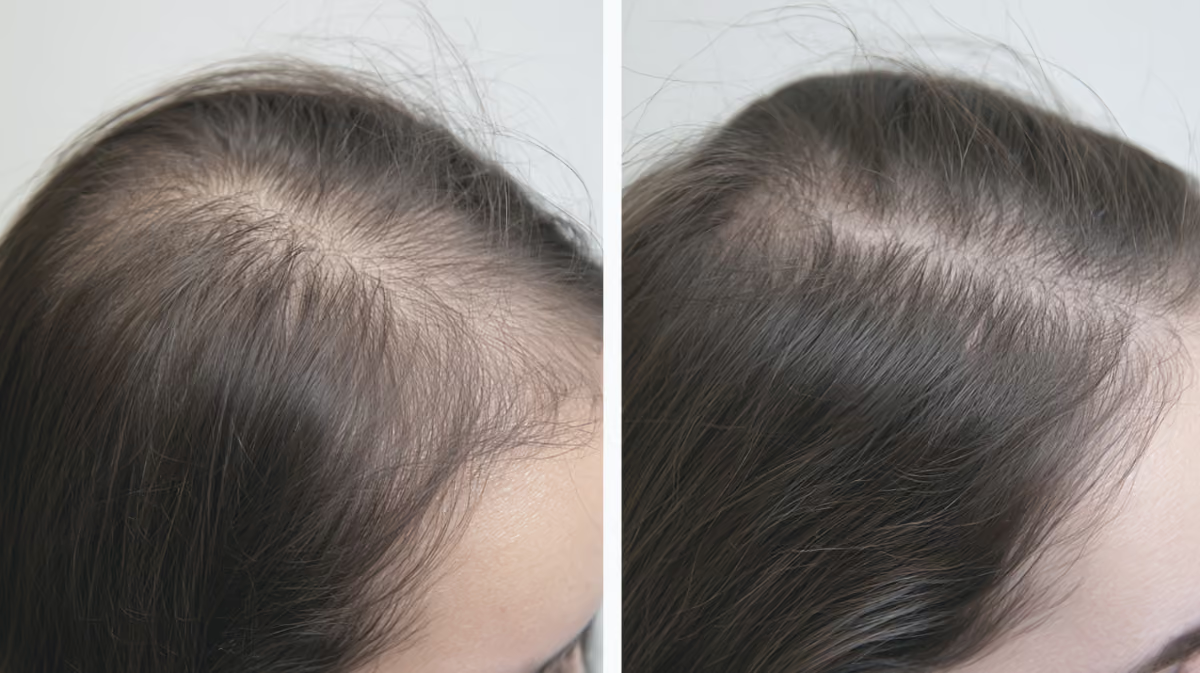
Before & after PRP/PRF
Part line and frontal density
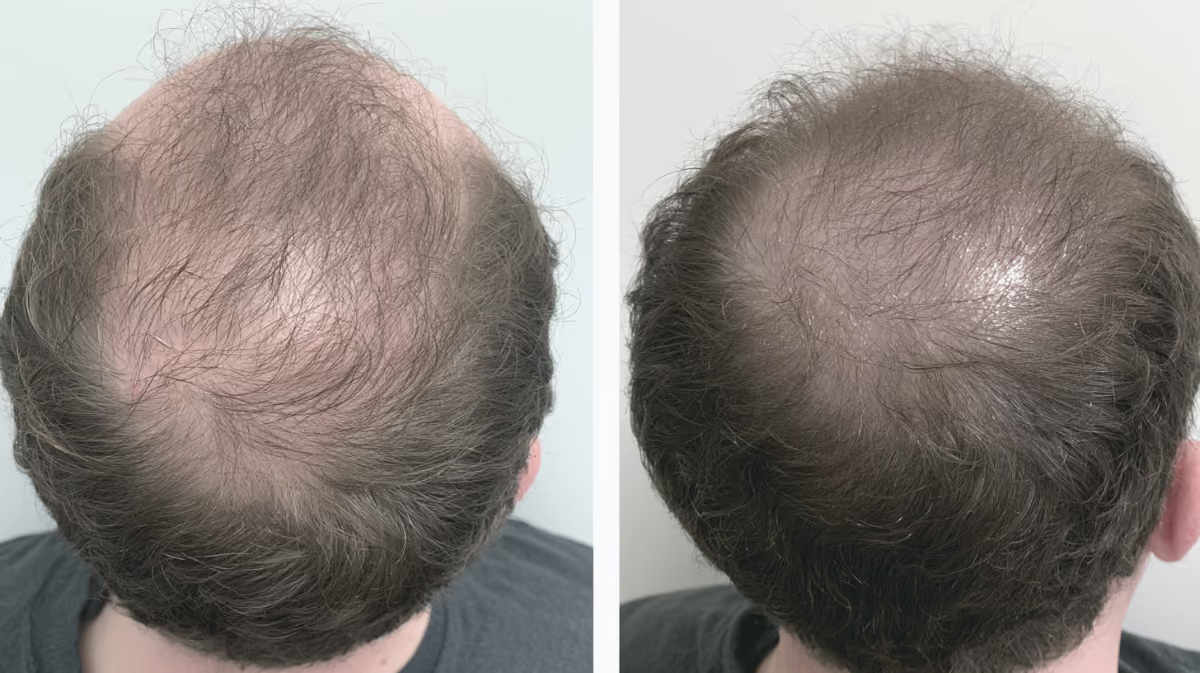
Before & after PRP/PRF
Coverage through the crown
Questions
Frequently Asked Questions
Is PRF better than PRP for hair restoration?
Neither can currently be considered universally superior. PRP has a larger body of clinical evidence, while PRF has a different biologic structure and a compelling rationale for more gradual release of signaling factors. Direct comparative evidence in hair loss remains limited.
Can PRP/PRF restore hair where the follicle is gone?
No. Regenerative treatments are intended to support follicles that remain viable. They cannot recreate a follicle that has been permanently destroyed.
Does PRF replace medical treatment?
Not necessarily. For many patients, identifying and treating the underlying cause of hair loss is the more important first step. PRP/PRF may be incorporated as an adjunct when appropriate.
How long does it take to see results?
Hair growth occurs slowly, so improvement develops over months rather than days. Your response is evaluated over time rather than judged immediately after treatment.
Is PRP/PRF appropriate for everyone?
No. Candidacy depends on the diagnosis, the condition of the follicles, overall health, and the cause and pattern of hair loss. A medical evaluation is the first step in determining whether PRP/PRF makes sense for you.
Last medically reviewed by Emma Kruger, M.D. · August 29, 2026
Begin with a conversation.
Hair restoration is most effective when it begins with an accurate understanding of what is being treated. At Metaglow, PRP/PRF is considered within that larger clinical picture — alongside medical evaluation, laboratory testing when appropriate, established therapies, and regenerative options.
If you are experiencing thinning or increased shedding, schedule a consultation with Dr. Emma Kruger to determine what may be contributing to the change and whether PRP/PRF belongs in your treatment plan.
